
- Flooring
Best Flooring for Pets in Red Deer: Top Picks That Still Look Luxe
April 1, 2026
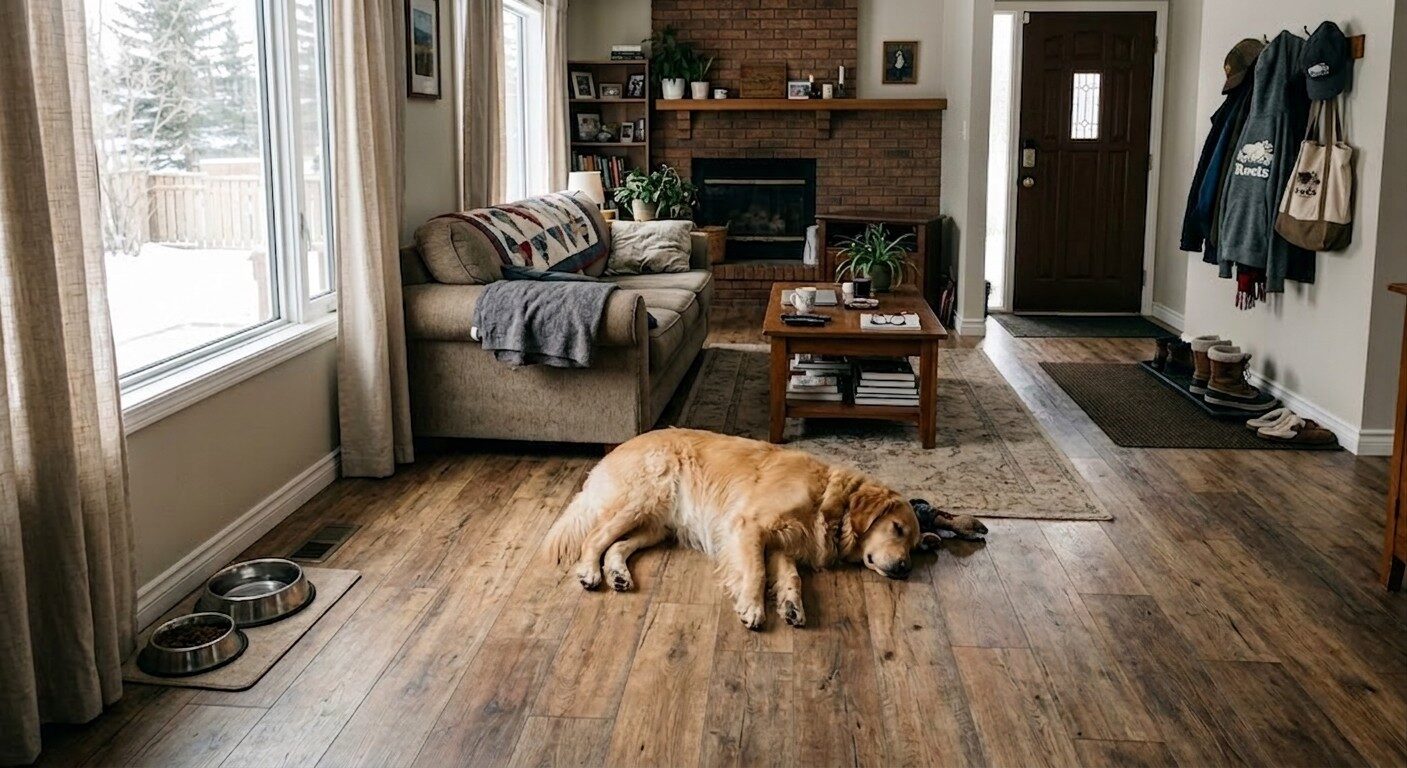
Most Central Alberta pet owners discover the limits of their flooring the same way: a dog shakes off after a walk, a water bowl slides two feet and soaks into a seam overnight, and the floor that looked beautiful in the showroom starts showing its age by spring. In Red Deer, that timeline is even shorter.
Indoor humidity in a Red Deer home swings from around 20–30% during furnace season to above 60% in summer, and those fluctuations put constant stress on any floor that isn’t built for it. Add a 70-pound lab into the mix, and you’re running one of the more demanding performance tests a floor will ever face.
Finding the best flooring for pets in Central Alberta means understanding what your floors are actually up against. This guide covers which options hold up, what each one costs to install here, and what to watch for when choosing who does the work.Want to skip ahead and see samples in person? Book a flooring consult or call us at 403-346-7088. Central Alberta Tile One has installed floors in Red Deer pet households since 1999, and the patterns we see in this climate repeat themselves reliably enough that we can tell you exactly what holds up and what doesn’t.
Why Red Deer’s Climate Makes Pet-Friendly Flooring More Complicated
Before any product discussion, it’s worth understanding why flooring decisions here aren’t the same as they are in Vancouver or Calgary. Red Deer sits in a humid continental climate, Köppen classification Dfb, which means no dry season, genuine winter cold, and meaningful temperature swings all year. Indoor humidity climbs above 60% in summer and can drop to 20–30% when you’re running your furnace hard through January and February.
That seasonal humidity cycle is the underlying cause of most flooring failures in this region. For wood-based products, it means constant expansion and contraction. For floors with pets, it creates a second layer of risk: your dog’s water bowl is sitting on a surface that’s already under moisture stress, and any spill or accident that stays wet for a few hours works directly against the seams, adhesive, or core material below.
Clay-heavy soils are common in Central Alberta, and clay expands and contracts with moisture changes, which places stress on slab-on-grade foundations. In newer neighbourhoods on the south and west edges of the city, including Kentwood, Vanier East, and the Timberlands area, many homes sit on engineered fill that can shift slightly over time. That movement transfers upward and shows up as cracked grout, popped LVP joints, or cupped hardwood. Freeze-thaw cycles every spring accelerate the process.
Here in Red Deer, the river valley that defines so much of the city’s geography also creates a wide range of subfloor conditions from one neighbourhood to the next. What works under a slab in Kentwood may not be the right spec for a basement suite in Riverside Meadows.
| Pro-Tip from the Central Alberta Tile One TeamIn areas like Kentwood and the Timberlands, we routinely see subfloor moisture readings that run higher than in established neighbourhoods closer to the city core, because of the younger fill and drainage profiles. Before we put any floor down in a pet household in those areas, we always run a full moisture assessment first. That one step prevents most of the callbacks we’d otherwise see two years later. |
What Is the Best Flooring for Pets in a Red Deer Home?
Three materials consistently come out on top when homeowners are searching for the best flooring for pets in Central Alberta: rigid core luxury vinyl plank, porcelain tile, and certain grades of engineered hardwood. Each has a real use case and real tradeoffs that salespeople often gloss over.
Rigid Core LVP (SPC): The High-Performance Workhorse
SPC, or stone plastic composite, is the construction type within the luxury vinyl plank family that makes the most sense for pet households in this climate. The rigid mineral core resists expansion and contraction through Red Deer’s humidity swings far better than entry-level WPC (wood plastic composite) cores, which are less dense and more susceptible to surface denting from concentrated pressure. The more important distinction for pet households, though, is moisture stability, where SPC holds a clear advantage over all WPC tiers.
A quality SPC product with a wear layer of at least 12 mil handles everyday claw traffic from most breeds without visible scratching. For large, high-energy dogs or multi-dog households, stepping up to 20 mil adds meaningful protection. The surface is 100% waterproof, so accidents, water bowl splashes, and wet paws from a January walk-in don’t reach the core.
You can find SPC options with textured surfaces that add traction, which matters a lot for senior dogs or any breed prone to hip issues.
| “Most pet owners come in asking about scratch resistance, and that’s valid. But in Red Deer, the bigger issue we see is moisture. Whether it’s a dog’s water bowl sitting on the floor, a pet accident that soaks in overnight, or the humidity shift when you’re running the furnace hard in January, the floor below the surface is where things go wrong first. Rigid core LVP protects against that better than almost anything else we carry.”— Troy Larsen, Co-Owner, Rave Design Showroom | 43 years in flooring |
Brands like Shaw Floors and Armstrong carry SPC lines with pet-specific wear ratings. The Resilient Floor Covering Institute (RFCI) provides independent guidance on wear layer standards and performance classification for vinyl flooring if you want to cross-reference any product spec sheet before you buy. You can also preview how these options look in your actual room using the Rave Design Showroom room visualizer before committing to anything.
The honest tradeoff with LVP: high-traffic pivot points, like the spot where a dog launches off the floor the same way every morning, will eventually show wear on softer products. Go thicker on the wear layer if you have large or high-energy breeds.
Browse our full flooring collection to see the SPC options we carry for every home type in Central Alberta.
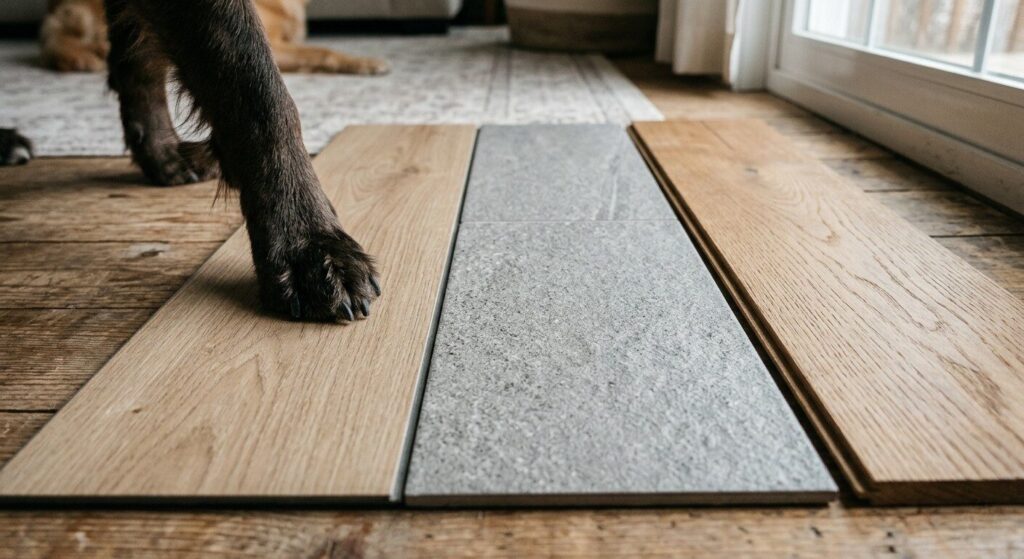
Porcelain Tile: The Definitive Pet-Proof Option
For homeowners who want the most durable, lowest-maintenance surface possible, porcelain tile is the answer. Dean Gillespie, co-owner and 46-year tile industry veteran at Rave Design Showroom:
| “Porcelain tile is genuinely the hardest-working surface you can put in a pet household. It doesn’t absorb anything, claws can’t touch it, and it’ll outlast the dog. The only real conversation is about texture. Smooth gloss tile gets slippery, especially when it’s wet. We always show pet owners the textured options first, because traction matters more than most people realize, especially for older dogs with joint issues.”— Dean Gillespie, Co-Owner, Rave Design Showroom | 46 years in the tile industry |
That protection applies to the tile body itself. On glazed porcelain, fine grit and sand carried in on dog paws can cause micro-scratches in the glaze layer over time, particularly on high-gloss finishes. For pet households, matte or full-body porcelain is the stronger specification. The colour and texture run through the tile, so surface wear is essentially invisible.
A textured porcelain tile with a suitable slip-resistance rating solves the safety concern for wet paws and spills. Wood-look porcelain tile has come a long way aesthetically and gives you the warmth of a hardwood look with none of the moisture vulnerability. The current industry standard for slip resistance is a minimum DCOF (Dynamic Coefficient of Friction) of 0.42 for level interior floors subject to wet conditions, per ANSI A137.1. For pet households, targeting a DCOF of 0.50 or above provides a meaningful safety margin beyond the regulatory minimum. The Tile Council of North America (TCNA) maintains the full DCOF standards reference and tile performance classifications if you want to verify a specific product’s rating before purchase.
The real tradeoff with tile is feel underfoot. Tile is cold in winter without in-floor heating, and hard on joints for both pets and people who stand a lot. Area rugs solve part of the problem, but they shift around on pets and need anti-slip backing. Budget for radiant heat if tile is going into a main living area.
See our porcelain and tile flooring options to find the textured and full-body options best suited for a pet household.
Engineered Hardwood: Possible, But Be Selective
Solid hardwood and pets is a combination most experienced installers will talk you out of in Central Alberta. The humidity cycle alone causes enough movement in solid wood that claw marks become a compounding problem, and any pet accident that isn’t caught within minutes starts working against the finish and core immediately.
Engineered hardwood is a different conversation. A well-constructed engineered product with a veneer layer of at least 3mm, a high-durability aluminum oxide finish, and a dense core handles pet households acceptably, especially in lower-traffic areas like bedrooms. Species selection matters: harder species like white oak, hickory, and hard maple are significantly more claw-resistant than softer woods like pine or cherry. For a deeper look at what happens when scratches do occur, our guide on hardwood floor scratches is worth reading before you decide.
Engineered hardwood is not the right choice for mudrooms, main-floor pet feeding areas, or any room with consistent moisture exposure. If wet paws are the daily norm at any entry point, keep engineered hardwood out of that space entirely.
Not sure if engineered hardwood is the right call for your space? Talk to our team and a five-minute conversation usually answers it.
What About Carpet and Other Options?
Carpet comes up often in pet flooring conversations, and the honest answer is that it’s the one surface most experienced flooring professionals steer pet owners away from. Carpet traps pet dander, hair, and odour deep in the fibres where regular vacuuming can’t fully reach. Once urine is in the backing and pad, no surface cleaning fully resolves it.
For allergy-sensitive households or homes with dogs prone to accidents, the long-term hygiene cost of carpet usually outweighs any comfort benefit. A hard-surface floor with a well-chosen area rug gives you the warmth of carpet underfoot without the maintenance burden.
Cork flooring is worth a mention for specific situations. It is naturally antimicrobial, provides a cushioned surface that is genuinely easier on ageing joints for both pets and their owners, and installs as a floating floor suitable for most rooms including basements.
Its softer surface is more susceptible to claw marks than SPC or tile, but for a household with older, lower-activity dogs where joint comfort is a priority, cork is a legitimate alternative. Central Alberta Tile One carries cork as a floating installation option.
| “So helpful in picking the flooring and tile. The guys they had doing the work were absolutely craftsmen of their trade. They kept in contact with us about timelines and satisfaction. Great price ranges and wonderful selection of flooring and tiles.”Red Deer Homeowner — Flooring & Tile Installation |
Keeping Pet Floors Looking Good Through an Alberta Winter and Summer
The biggest maintenance mistake pet owners make in this climate is treating floor care as a single set of habits year-round. Red Deer’s humidity swing means your maintenance approach needs to shift by season.
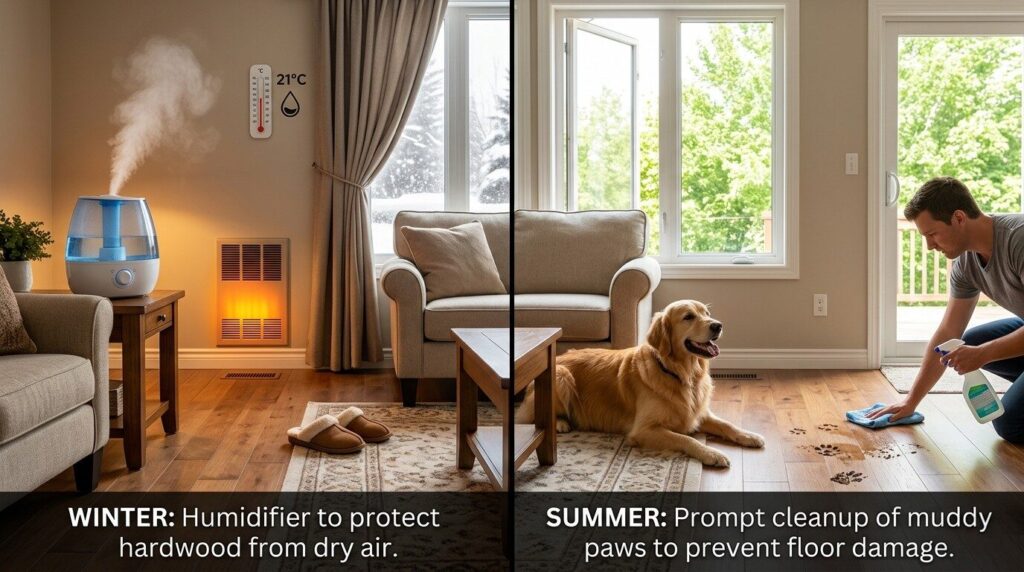
During furnace season, November through March, indoor air is dry. Hardwood and engineered wood products contract during this period, and small gaps between planks are normal. Running a whole-home humidifier to keep indoor humidity between 40% and 50% reduces that movement significantly. According to the National Wood Flooring Association (NWFA), wood floors perform best when maintained between 35% and 55% relative indoor humidity year-round.
In summer, the opposite applies. Humidity climbs and floors can expand, especially lower-quality LVP without a dense SPC core. For pet households, this season also means more wet paws tracked in and more mud. A good entry mat at every exterior door is the single cheapest maintenance investment you can make.
For all floor types, the key to long-term appearance in a pet household is surface pH management. Standard household cleaners that are too alkaline will strip the finish on LVP and damage grout sealant over time. Use pH-neutral cleaners specific to your floor type. Brands like Bona for hardwood and Armstrong for vinyl are available at Rave Design Showroom.
Claw marks on LVP can often be addressed with a manufacturer-approved touch-up kit. On engineered hardwood, a professional re-coat of the finish layer every five to seven years restores the protective layer without full replacement.
The maintenance question that gets skipped most often: when to reseal grout in a tile installation. In a pet household, unsealed grout is a hygiene problem, not just an aesthetic one. The simplest way to know when to reseal: drop water on the grout. If it beads, the sealer is holding. If it absorbs, it’s time. In a pet household, check quarterly. Resealing frequency depends on the sealer type used during installation, so confirm with your installer whether you have a penetrating or surface sealer, as these have different maintenance timelines.
| “I was more than happy with my experience with Tile One, right from my first call to project completed. Every person I dealt with was professional and personable.”Red Deer Homeowner — Flooring Installation |
How to Choose a Flooring Installer in Red Deer for a Pet Household
Choosing the right installer matters as much as choosing the right product. Before you sign anything, run through this checklist.
1. Ask for a subfloor assessment before any quote. Any installer who quotes a pet-household floor without asking about subfloor type, age, and condition is skipping the step that determines whether your floor lasts five years or fifteen. In Red Deer’s clay-soil conditions, subfloor moisture levels can vary widely even between adjacent rooms. Ask specifically whether they perform a moisture reading before installation, and whether the quote includes subfloor prep if it’s needed.
2. Ask what a proper moisture test looks like. A reliable installer uses a calibrated moisture meter or calcium chloride test on concrete slabs, and a pin or pinless meter on wood subfloors. Ask them to document that result in writing before work begins. Skipping moisture testing is the single most common shortcut that leads to warranty voidance and early floor failure.
3. Ask for warranty details in writing. Product warranties and labour warranties are different documents. Understand both before signing. Vague language about ‘defects at installation’ with no timeline is not acceptable. A professional installer will explain exactly what is and isn’t covered.
4. Ask for references from a completed pet-household project. A flooring installer with real experience in pet homes can point you to a specific project, not just a general review. Ask how the floor has held up, whether any moisture issues appeared in the first year, and whether the homeowner would hire them again.
At Central Alberta Tile One, every project begins with an in-person site visit and subfloor assessment before any pricing is finalized. The team page gives you a direct look at the experience behind the quotes you’ll receive. You can also review answers to common installation questions on the FAQ page. For a broader look at evaluating your options, our post on choosing the right flooring product covers the decision framework in detail.
Frequently Asked Questions: Pet-Proof Flooring in Red Deer
How much does pet-friendly flooring cost to install in Red Deer?
For a 300 sq ft space, expect $1,800 to $3,600 for rigid core LVP installed, or $2,700 to $6,300 for porcelain tile. Engineered hardwood in the same space typically runs $2,550 to $5,400. Subfloor preparation, moisture barriers, and removal of existing flooring are usually separate line items. Always request a fully itemized quote before committing.
How does Red Deer’s humidity swing affect which flooring I should choose for my pets?
Indoor humidity in a Red Deer home shifts from 20–30% in winter to above 60% in summer. That range causes real expansion and contraction in any wood-based product. For pet households, rigid core LVP or porcelain tile offer the most stable performance year-round, because neither product is meaningfully affected by humidity movement the way solid or engineered wood can be.
How long does a pet-friendly flooring installation take in Red Deer?
A typical residential flooring project takes one to three days for installation after product delivery, depending on square footage and floor type. Tile installations with heated subfloor systems can take three to five days. Subfloor prep, if needed, adds one day. From initial showroom consult to completed installation, four to six weeks is a realistic timeline for in-stock products.
How do I know when my pet-household floor needs replacing versus refinishing?
On engineered hardwood, the veneer layer thickness determines how many times refinishing is possible. Most quality products allow one or two refinishes. On LVP, once the wear layer has worn through or tiles are cracking from subfloor movement, replacement is the only real fix. For tile, if more than 10% of tiles in a room show cracking or grout failure, full replacement is typically more cost-effective than piecemeal repairs.
Is laminate flooring a good option for a home with pets?
Standard laminate with an AC3 or lower rating will show wear from large dogs within a few years. An AC5-rated laminate with a waterproof core performs better, but even the best laminate is significantly more vulnerable to moisture intrusion at seams than SPC LVP. No click-lock floor is completely impervious to a prolonged saturation event. If budget is the main driver, choose the highest AC rating available and clean up moisture immediately.
What flooring is best for dogs that shed a lot?
Hard-surface flooring is the clear answer for heavy shedders. Pet hair sits on the surface of LVP, tile, and hardwood rather than embedding in fibres the way it does in carpet. A smooth or lightly textured SPC floor is the easiest to maintain: a dry Swiffer or robot vacuum picks up shedded hair without it becoming trapped in grout lines or surface texture. Avoid high-textured tile in a heavy-shedding household unless you are prepared for more thorough regular cleaning.
Is luxury vinyl plank flooring slippery for dogs?
It depends on the surface finish. Smooth, high-gloss LVP can be slippery for dogs, particularly on corners and directional changes, and is a real concern for senior dogs or breeds with hip or joint issues. Matte-finish and lightly embossed SPC products offer meaningfully better traction. When selecting LVP for a pet household, ask specifically about the surface texture and request a sample to test with wet hands. If it’s slippery for you, it’s slippery for the dog.
What is the best flooring for a dog that has accidents?
Waterproof rigid core LVP or full-body porcelain tile are the only two materials that give you a genuine defence against repeated pet accidents. Both are non-porous at the surface, meaning urine cannot absorb into the flooring material itself. The critical variable is the subfloor: a pet accident that sits long enough will migrate through any click-lock seam and reach the subfloor below. Clean up accidents within 30 minutes and inspect seams annually in accident-prone areas for any signs of moisture infiltration.
Ready to Find a Floor Your Pets Can’t Destroy?
The right floor for a pet household in Red Deer is one that was chosen with this climate in mind, installed on a properly assessed subfloor, and maintained with habits that match Alberta’s seasonal humidity. That combination outlasts almost anything the dogs can put it through.
Central Alberta Tile One has been helping Red Deer homeowners get that combination right since 1999. We are a proud member of the Canadian Home Builders’ Association, RenoMark certified, and COR-recognized, so you know the team walking into your home meets a verified professional standard.
Our showroom at #9, 7619 50 Ave, Red Deer, AB is open Monday through Friday, 8 AM to 5 PM, and Saturday from 10 AM to 4 PM. No appointment needed to come in and look around.
When you’re ready to talk specifics, call us at 403-346-7088 or book a flooring consult online. We’ll walk through your space, your pets, and your budget, and give you a straight answer about what actually makes sense.
You Might Also Like
-
- Flooring
March 17, 2026
Best Kitchen Flooring in Red Deer: Spills, Traffic and Style
-
- Flooring
October 10, 2025
The Unexpected Pairings: Why Mixing Flooring Materials Create Dynamic Open-Concept Spaces:
-
- Flooring
July 21, 2025
Pet Friendly Flooring Guide