
- Flooring
Best Kitchen Flooring in Red Deer: Spills, Traffic and Style
March 17, 2026
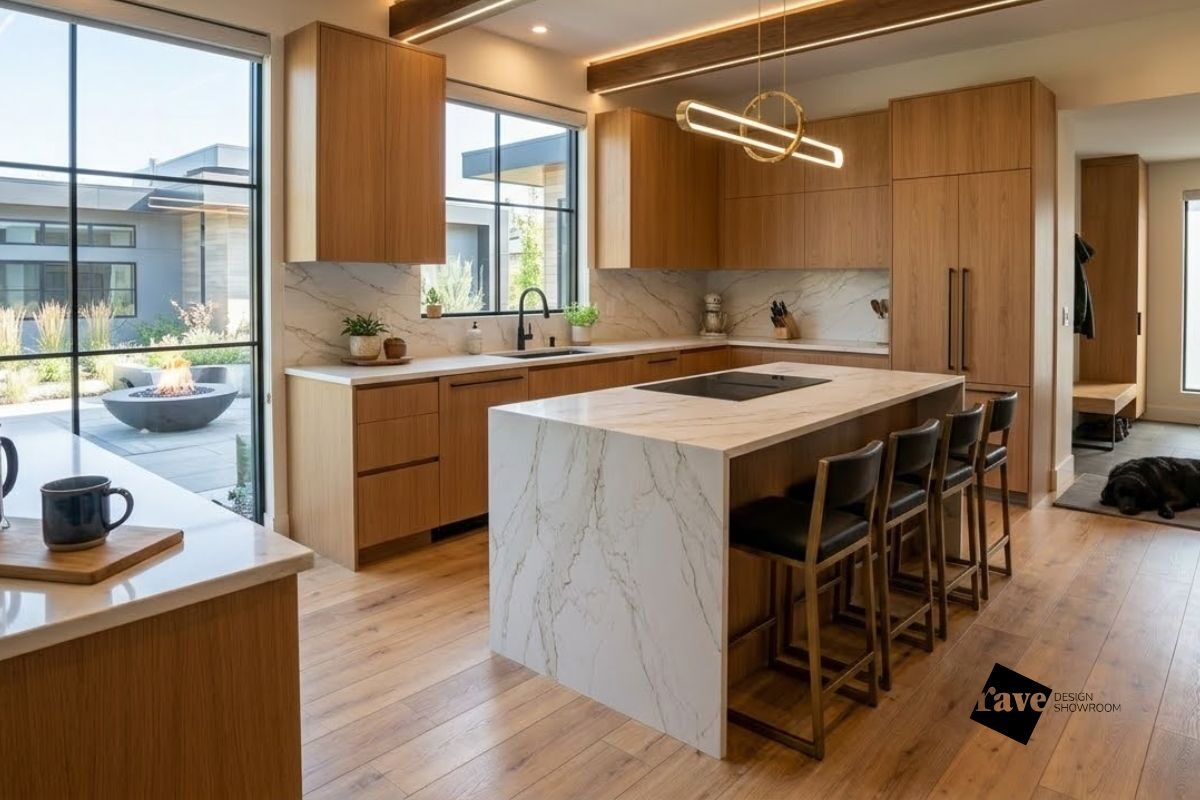
Most homeowners in Red Deer choose their kitchen floor based on how it looks in a showroom. They find out what it actually does, or doesn’t do, after the first Alberta winter.
Humidity swings from 88% in February to 55% in May.
Temperatures outside can drop past -25°C. Inside, you’re running the furnace, tracking in grit from gravel roads, and cooking meals for a family in a space that gets used hard, every day. What works in a Vancouver kitchen or a Toronto condo doesn’t always hold up here in Central Alberta.
The right kitchen floor handles all of it. The wrong one will gap, buckle, stain, or feel like ice under your feet by November.
At Rave Showroom in Red Deer, our team has been installing floors across Central Alberta since 1999. We’ve seen what holds up in this climate and what doesn’t. This guide gives you the real picture so you can make a confident decision before you buy.
Ready to see your options in person? Book a showroom visit or call 403-348-8280.
Why Red Deer Kitchens Are Harder on Floors Than Most
Central Alberta puts flooring through a stress test that most product specs don’t account for. Understanding what’s happening beneath your feet, and in the air around your floors, explains why the same product that lasts 20 years in a Calgary condo sometimes fails in five here.
Humidity swings are the biggest variable. Red Deer’s relative humidity runs from a high of around 88% in February and March down to roughly 55–64% through the warmer months (Weather Atlas, Red Deer Climate Data). That’s a swing of 25 to 30 percentage points over the course of a year. Think of it like a sponge that gets wrung out every spring and soaked every winter. For wood-based floors, that cycle means constant expansion and contraction, and kitchens are the worst room in the house for it because steam from cooking adds a third moisture source on top of seasonal swings.
The climate classification matters. Red Deer sits in a humid continental climate (Köppen Dfb), meaning no dry season and meaningful temperature swings year-round. Winters drop well past -15°C, and summer days reach the low-to-mid 20s Celsius. Freeze-thaw cycles in spring affect any slab-on-grade subfloor, and homes in newer developments on the south and west edges of the city, like those in Kentwood, Vanier East, or the Timberlands area, often sit on engineered fill that can shift slightly over time. That movement transfers upward through the subfloor and shows up as cracked grout, popped LVP joints, or cupped hardwood.
Soil conditions matter more than most installers will tell you. Red Deer County and the city itself sit on glacially deposited clay-rich soils that retain moisture and compress under load. This drives moisture migration through concrete slabs, particularly in homes with main-floor kitchens on slab foundations. Adhesive failure, grout cracking at tile joints, and LVP click joints pulling apart are all failure modes we trace back to slab moisture that wasn’t tested before installation.
Pro-Tip: Rave Showroom Team: In homes built on concrete slabs in Red Deer’s newer southwest neighbourhoods, we consistently see subfloor moisture readings above acceptable installation thresholds. Before we install any flooring in those kitchens, we run a calcium chloride or RH probe test. Skipping that step is the most common reason a “five-year floor” fails in two.
The Red Deer Regional Hospital, just a few kilometres from our showroom, sits at the heart of a city that’s grown steadily for decades. Kitchen renovations here reflect that growth, from new builds in the Timberlands to older infills in Glendale and Oriole Park, and large custom homes throughout Red Deer County. Every construction era comes with its own subfloor conditions, and your floor choice needs to account for those realities.
Browse our full flooring selection to see the options we carry for every home type in Central Alberta.
What’s Actually the Best Kitchen Flooring? A Practical Comparison
Most articles give you a tidy ranking here. The real answer is more useful: the best kitchen flooring depends on your subfloor, your lifestyle, and how much you’re willing to spend. Here’s an honest breakdown of the three options we most frequently recommend for Red Deer kitchens.
Rigid Core LVP (Also Called SPC): The Workhorse of Modern Kitchens
Rigid core LVP, sometimes called SPC or stone plastic composite, is a specific construction type within the broader luxury vinyl plank category. It’s the version built for kitchens, and for most Red Deer homeowners it’s the single most practical choice.
It’s water-resistant, which matters when a pot boils over, a pet’s water bowl gets kicked, or a dishwasher leak goes unnoticed for a day. The stone-plastic composite core resists expansion and contraction in a way that directly addresses Red Deer’s humidity swing problem. Where a wood-based product may gap in January and swell in March, a quality SPC plank stays flat through the full seasonal cycle.
Wood-look vinyl in warm oak tones and matte finishes is one of the most requested looks in kitchen renovations right now. Extra-wide planks in the 7-to-9-inch range reduce the number of seams in a room and create a cleaner visual flow. Herringbone patterns in LVP are gaining traction for homeowners who want visual interest without the commitment of natural stone.
The honest tradeoff: LVP can feel hollow underfoot, particularly over uneven subfloors. Thicker products with attached underlayment help, but you can still hear the difference compared to tile or hardwood. For a family kitchen with kids, pets, and regular traffic, we recommend a minimum 12 mil wear layer, the residential standard for high-use spaces. Step up to 20 mil if you’re running a home-based business from the space, have very large dogs, or want the added confidence of a commercial-grade product.
For rigid core LVP in a Red Deer kitchen, COREtec is one of the strongest performers we carry. Its stone-plastic composite core was engineered specifically to resist the temperature and humidity cycling that causes lesser products to expand and gap. Karndean Designflooring is another standout: their Van Gogh and LooseLay collections offer exceptional visual depth and a beveled edge profile that reads more like real hardwood than most products at any price point. Shaw’s Floorté line rounds out the options for homeowners who want a proven brand with a broad palette.
“In Red Deer kitchens, we always steer clients toward a rigid core SPC with a 12 mil or better wear layer. The humidity swings we get here, especially in homes near the river valley, can destroy a thinner product within a few years. The extra investment in the wear layer is the cheapest insurance you can buy.” – The Rave Showroom Team
Porcelain Tile
Tile is the most durable kitchen flooring you can install. Full stop. A properly installed large-format porcelain tile will outlast your kitchen cabinets, your appliances, and very possibly the mortgage. It’s non-porous, impervious to water, and handles any level of foot traffic without complaint.
Large format tiles, 24×24 or 24×48 inch slabs, are a strong 2026 trend and genuinely practical in kitchens. Fewer grout lines mean less cleaning, and the seamless visual reads as expansive and modern. Stone-look porcelain in warm greige and terracotta tones pairs exceptionally well with the warm neutral countertop palettes we’re seeing in Central Alberta new builds.
One important note on finish: for kitchen floors, always choose a matte, textured, or low-sheen surface rather than a polished one. Polished porcelain is stunning on walls and in dry spaces, but in a kitchen where water and cooking residue hit the floor regularly, a matte or structured finish provides meaningfully better slip resistance. The TCNA recommends a minimum Dynamic Coefficient of Friction (DCOF) of 0.42 for floors in wet areas. Most Daltile and Marazzi kitchen-rated tiles meet or exceed this threshold. Ask our team to confirm the specific product’s DCOF rating before you finalize your selection.
The honest tradeoffs: tile is unforgiving underfoot. Standing on it for extended periods while cooking is harder on joints and feet than vinyl or hardwood. Anti-fatigue mats help, but they add clutter. Tile is also cold, which matters in a Red Deer winter. In-floor radiant heat addresses this directly and is increasingly common in the kitchen renovations we see across the city.
The other tradeoff is grout. Darker grout hides staining better than white, but even sealed grout needs annual attention to stay clean. Rectified tiles with thin grout lines significantly reduce the maintenance burden. For installation, tile requires a flat, solid subfloor. The TCNA specifies a maximum deflection of L/360 for tile installations, meaning the subfloor must be stiff enough that it deflects no more than 1/360th of its span under load. Older bungalows in Red Deer’s Glendale or Bower neighbourhoods sometimes need subfloor reinforcement before tile can go down. A proper assessment before quoting saves everyone time and money.
Engineered Hardwood
The question we hear most often: “Can I put hardwood in my kitchen?”
The answer is yes, with the right product and proper installation. Engineered hardwood is the version designed to handle the humidity fluctuations in Red Deer kitchens that would destroy solid hardwood over time. It has a real wood veneer layer over a dimensionally stable plywood or HDF core, which means it expands and contracts far less than solid wood under seasonal humidity changes.
Wide plank engineered oak in honey or warm blonde tones is one of the most requested looks in kitchen renovations right now. It creates warmth that tile and vinyl can’t fully replicate, and it genuinely adds resale value reflected in Central Alberta home appraisals.
The honest tradeoffs: engineered hardwood is not waterproof. A water-resistant finish protects against splashes, but sustained moisture exposure from a slow leak under the dishwasher or sink will cause swelling and cupping. For households with very young children, active pets, or a history of appliance leaks, LVP gets you 90% of the visual result with significantly more forgiveness.
According to the National Wood Flooring Association (NWFA), the recommended indoor humidity range for engineered hardwood is 35–55% RH, though individual manufacturers vary. Lauzon, for example, specifies 40–60% for most of their engineered collections. Red Deer winters can push interior humidity below 30% without a humidifier. Staying in the 38–50% range is our practical local recommendation. It keeps you comfortably within the NWFA’s 35–55% standard while accounting for the swings a hard Alberta winter puts on your HVAC system. A whole-home humidifier is not optional if you go with engineered hardwood in your kitchen.
Acclimation is equally non-negotiable. Engineered hardwood must sit in the installation space, not in a garage or warehouse, for a minimum of 48 to 72 hours before installation. This allows the product to adjust to the room’s temperature and humidity before it’s locked in place. Skipping this step is one of the leading causes of gapping and callbacks we see in the field, particularly when product arrives cold in an Alberta winter.
“Engineered hardwood in a kitchen is absolutely doable in Red Deer, but only if the moisture prep is done right. I’ve seen beautiful floors start cupping within a year because the installer skipped the acclimation step or didn’t run a moisture test on the slab. The floor is never the problem. The preparation is.” – Troy Larsen, Owner/Operator, Rave Showroom
“Fantastic service and quality work. Thank you Shannon, Troy, Sierra & Ariel! The team went above and beyond showing us different products and ensuring we had the best materials for our project with a great install.” – First Choice Collision
LVP vs. Tile vs. Engineered Hardwood: A Quick Comparison for Red Deer Kitchens
Not sure which direction is right for your kitchen? This table covers the eight questions Red Deer homeowners ask most when comparing the three top flooring options.
| Feature | Rigid Core LVP | Porcelain Tile | Engineered Hardwood |
|---|---|---|---|
| Waterproof | Waterproof (with proper installation) | Waterproof (with proper installation) | No, water-resistant only |
| Cold underfoot | Warm | Cold (radiant heat recommended) | Warm |
| Humidity tolerance | Excellent, unaffected by RH swings | Excellent | Good, requires humidifier in winter |
| Slip resistance | Good, textured wear layer | Varies, always specify matte or textured finish | Good |
| Pet and kid durability | Excellent, 12 to 20 mil wear layer | Excellent | Moderate, susceptible to deep scratches |
| Resale value impact | Moderate | High | High |
| Installed cost in Red Deer | $5–$10.50 per sq ft | $9–$21+ per sq ft | $9–$21 per sq ft |
| Best for | High-traffic family kitchens, leak-prone homes | Long-term investment, custom builds | Buyers wanting real wood warmth and resale appeal |
Use this table as a starting point. The right choice for your specific kitchen depends on your subfloor condition, your home’s age, and how you use the space. Our team can walk you through each option side by side when you visit the showroom.
What Does Kitchen Flooring Actually Cost in Red Deer?
Pricing in Central Alberta is more competitive than Ontario or BC, partly due to lower labour costs and better material availability through regional distribution. These figures reflect 2026 Alberta market rates and are intended as planning ranges, not fixed quotes. Source: floorcostcalculator.com, Alberta regional data.
| Flooring Type | Total Installed (per sq ft) | Local Notes |
|---|---|---|
| LVP / SPC Vinyl Plank | $5.00–$10.50 | Entry-level to premium COREtec and Karndean; slab prep adds cost in newer subdivisions |
| Porcelain Tile | $9.00–$21.00+ | Large format and heated floors push price up; strong long-term ROI |
| Engineered Hardwood | $9.00–$21.00 | Requires moisture assessment; budget an additional $500–$1,200 for whole-home humidifier |
| Laminate | $5.50–$10.00 | Standard laminate not recommended for full kitchens. Next-gen water resistant laminate (TORLYS) is a viable option for low-leak-risk kitchens, confirm subfloor moisture levels first |
Subfloor condition is the biggest wildcard in Red Deer pricing. Older homes in Riverside Meadows or Fairview sometimes have plywood subfloors with water damage or settlement cracks that need repair before any new floor goes in. That preparation work typically adds $1.50 to $3.00 per sq ft on top of the installation cost. Regional material availability also plays a role. Larger format tile and premium SPC products are stocked locally, but custom-spec products may require a two-to-three week lead time from Calgary or Edmonton distributors.
Want a quote built around your actual space? Visit our showroom this week, no pressure, no obligation. Our team does site visits and quotes for kitchen flooring projects across Red Deer and Central Alberta.
Not ready to visit yet? Tell us your kitchen size and top priorities, waterproof, pet-friendly, or warm underfoot, and we’ll put together a curated sample selection you can review at home before you commit. Fill out our lead form or call 403-348-8280 and we’ll take it from there.
Living With Your Kitchen Floor: The Maintenance Reality
Choosing the right floor is half the decision. Knowing how to look after it through Red Deer’s seasons is the other half.
LVP and SPC vinyl are legitimately low-maintenance. Sweep or vacuum regularly to keep grit off the wear layer and damp-mop as needed. The one maintenance mistake we see most often: homeowners use steam mops on LVP. Don’t. The heat and moisture can warp the click joints and void most manufacturer warranties. Use only the cleaner listed in your specific product’s care guide. COREtec, Karndean, and Shaw each publish approved cleaner lists, and using an off-list product, even a pH-neutral one, can affect the finish warranty. When in doubt, plain warm water and a microfiber mop is always safe.
In Red Deer’s dry winter months, very low humidity won’t affect SPC flooring the way it affects wood. But it can affect the adhesive bond around transition strips and the silicone caulk at walls. Check these annually and reseal if they’re pulling away.
Porcelain tile requires one non-negotiable maintenance habit: annual grout sealing. Unsealed grout in a kitchen absorbs cooking grease, foot traffic grime, and spills in a way that becomes nearly impossible to reverse without professional cleaning. Use a penetrating sealer each fall before the dry winter season hits. Cracked grout at perimeter edges is a common issue in Red Deer because of freeze-thaw movement in spring. Repair these quickly before water infiltrates the substrate.
Engineered hardwood demands respect for Red Deer’s humidity cycle. According to the NWFA, the recommended indoor humidity range for engineered hardwood is 35–55% RH. In Red Deer winters, running a humidifier is non-negotiable. Staying in the 38–50% range is our practical local recommendation. It keeps you comfortably within that standard while accounting for what an Alberta furnace does to your indoor air from November through March. Avoid wet mopping. Clean with a hardwood-specific cleaner and a barely damp microfiber pad. Refinishing is possible on most engineered products once or twice over the life of the floor, a genuine advantage over LVP.
One maintenance mistake that quietly shortens floor life across all categories in our region: dragging appliances or furniture without felt pads or protective sliders. Refrigerators, ranges, and dishwashers pulled across a kitchen floor during a renovation or cleaning session leave scratches and gouges that no maintenance routine can reverse.
“All the staff are extremely helpful and knowlegeable. Good product in all departments.” – Barb Coutts
How to Choose a Flooring Installer in Red Deer: What to Ask Before You Sign Anything
The right floor installed wrong will fail. The wrong floor installed right will still fail. Both are avoidable if you ask the right questions before any installation begins.
Ask about subfloor assessment first. Any contractor who quotes a kitchen floor without asking about your subfloor type, the age of the home, and whether there’s ever been a water leak under the kitchen is skipping a critical step. At Rave Showroom, we assess every kitchen subfloor before we quote, because the prep work is often what determines whether a floor lasts 5 years or 25.
Ask specifically about moisture testing. Concrete slabs can emit moisture vapour that doesn’t feel wet to the touch but will destroy adhesives, cause LVP to cup, and cause grout to crack over time. A proper moisture test uses calcium chloride testing or an in-situ RH probe, both of which require several days to produce reliable results. If a contractor says they “checked for moisture” by pressing their hand to the slab, that’s a red flag.
Watch for vague warranty language. Product warranties and installation warranties are different things. Many product warranties require professional installation to be valid, and some specify particular adhesive or underlayment products. Ask your installer to show you the warranty requirements for the specific product you’re buying, and confirm their installation method meets those requirements.
Red flags in a quote include no in-person site visit before pricing, no mention of subfloor preparation or moisture assessment, no itemized breakdown of labour vs. material, or a quote that comes in significantly lower than the ranges in the pricing table above without explanation.
Our team from Central Alberta Tile One conducts in-home assessments before every installation, runs moisture readings on any slab-on-grade kitchen, and documents the subfloor condition as part of the project file. Our interior design services can also help you coordinate your floor choice with countertops, cabinetry, and lighting so everything works together as a finished room. For more complex renovations, our financing options mean you don’t have to compromise on material quality because of cash flow timing.
For additional reading, our post on 10 designer tips to add value to your home covers the kitchen remodel in context with the other upgrades that drive the strongest return in Central Alberta homes. If you’re also planning countertop work, our quartz vs. granite guide for Red Deer walks through the material tradeoffs in the same climate-aware way.
Frequently Asked Questions About Kitchen Flooring in Red Deer
How much does kitchen flooring cost to install in Red Deer?
Based on current 2026 Alberta market data, expect $5 to $10.50 per sq ft installed for luxury vinyl plank, and $9 to $21 per sq ft for porcelain tile or engineered hardwood. A typical Red Deer kitchen of 200 sq ft comes out to roughly $1,000 to $4,200 for LVP, or $1,800 to $4,200-plus for tile or hardwood. Subfloor preparation and moisture barrier work are usually additional, so always ask for a fully itemized quote. Visit our showroom for a project-specific estimate.
How does Red Deer’s humidity swing affect which kitchen floor I should choose?
Humidity in Red Deer ranges from approximately 55% in summer to 88% in February and March. For wood-based products, that’s a constant expansion-and-contraction cycle that can cause gapping, cupping, and finish damage over time. Solid hardwood is generally not recommended for Red Deer kitchens. Engineered hardwood handles the swings better, with a recommended indoor humidity range of 35–55% RH, though manufacturers like Lauzon specify up to 60% for their engineered collections. A whole-home humidifier keeps your floor within that range in winter. Rigid core SPC vinyl is essentially unaffected by humidity shifts and is often the most stable choice for this region.
What does the installation process look like, from consultation to completed floor?
At Rave Showroom, the process starts with a showroom visit or a consultation call. We follow that with an in-home assessment to evaluate your subfloor, measure the space, and identify any prep work needed. Material lead times vary from same-week for stocked products to two to three weeks for special orders. Installation typically takes one to two days for LVP and three to four days for tile, including grout curing time. We manage the full process through our installation team at Central Alberta Tile One.
How do I know when my kitchen floor actually needs replacing vs. just refinishing or resealing?
LVP and tile don’t get refinished. When the wear layer on LVP is visibly worn through or the surface is chipping, it’s time to replace. Tile itself almost never needs full replacement; grout and individual cracked tiles can be repaired cost-effectively. Engineered hardwood can typically be lightly sanded and refinished once or twice over its lifespan, depending on veneer thickness. The most reliable indicator across all floor types: if it’s soft, spongy, or visibly moving when you walk on it, that’s a subfloor issue requiring immediate attention regardless of what the surface looks like.
Will luxury vinyl plank look cheap in my kitchen?
This is the most common misconception that leads homeowners to overspend on materials that aren’t right for their lifestyle. Premium rigid core SPC in wide plank formats with embossed-in-register textures, meaning the surface texture is precisely aligned with the printed wood grain beneath it just like real wood, closely replicates the look and feel of hardwood. At the premium tier, most homeowners are genuinely surprised by how convincing these floors are in a finished kitchen. Thinner, lower-cost LVP products with uniform textures do read as synthetic. The difference isn’t the product category. It’s the quality tier within that category. At Rave Showroom, we show you the full range side by side so you can make that comparison with your own eyes before deciding.
Visit the Rave Showroom, Red Deer’s Flooring Destination
The best kitchen flooring decision starts with seeing and touching the real product in a real showroom. Photos don’t capture texture, sheen, or scale the way standing in a finished room display does.
At Rave Showroom, we carry flooring, countertops, lighting, and interior design services under one roof. Your kitchen floor decision doesn’t happen in isolation here. Our team can walk you through how each flooring option works with the countertop and cabinetry directions trending in Central Alberta right now, from warm quartz surfaces paired with wide-plank LVP to large-format tile paired with matte hardware and natural stone counters. Check out our FAQ page for more common questions about our products and process.
Stop in any day this week, no appointment needed. Tell us you’re choosing kitchen flooring and our team will pull the three to five products most commonly installed in Red Deer kitchens right now, so you can compare them side by side in about 20 minutes. Most people leave with a clear frontrunner.
Rave Showroom 7619 50 Ave #6, Red Deer, AB T4P 1M6 Phone: 403-348-8280 Monday–Friday: 8 am–5 pm | Saturday: 10 am–4 pm Book a showroom visit
Written by the Rave Showroom team. Shannon Moench (Owner/Operator) has been in the flooring industry since 1985 and founded Central Alberta Tile One in 1999. Troy Larsen (Owner/Operator) brings 43 years of hands-on experience across hardwood, laminate, luxury vinyl, and carpet. Dean Gillespie (Owner/Operator) has spent over 46 years in the tile industry, from residential remodels to large-scale commercial builds. Meet the full team.
You Might Also Like
-
- Flooring
August 19, 2026
Commercial Flooring in Red Deer: What Property Managers and Business Owners Need to Know
-
- Flooring
August 13, 2026
The Best Flooring for Alberta Basements: What Works When the Ground Gets Cold
-
- Flooring
July 20, 2026
Hardwood vs. LVP Flooring: Which One Actually Holds Up in Red Deer’s Climate?