- Lighting
- |
- Interior Decor
- |
- Kitchen Renovation
Kitchen Island Lighting Spacing: The Red Deer New-Build Guide for 2026
April 30, 2026
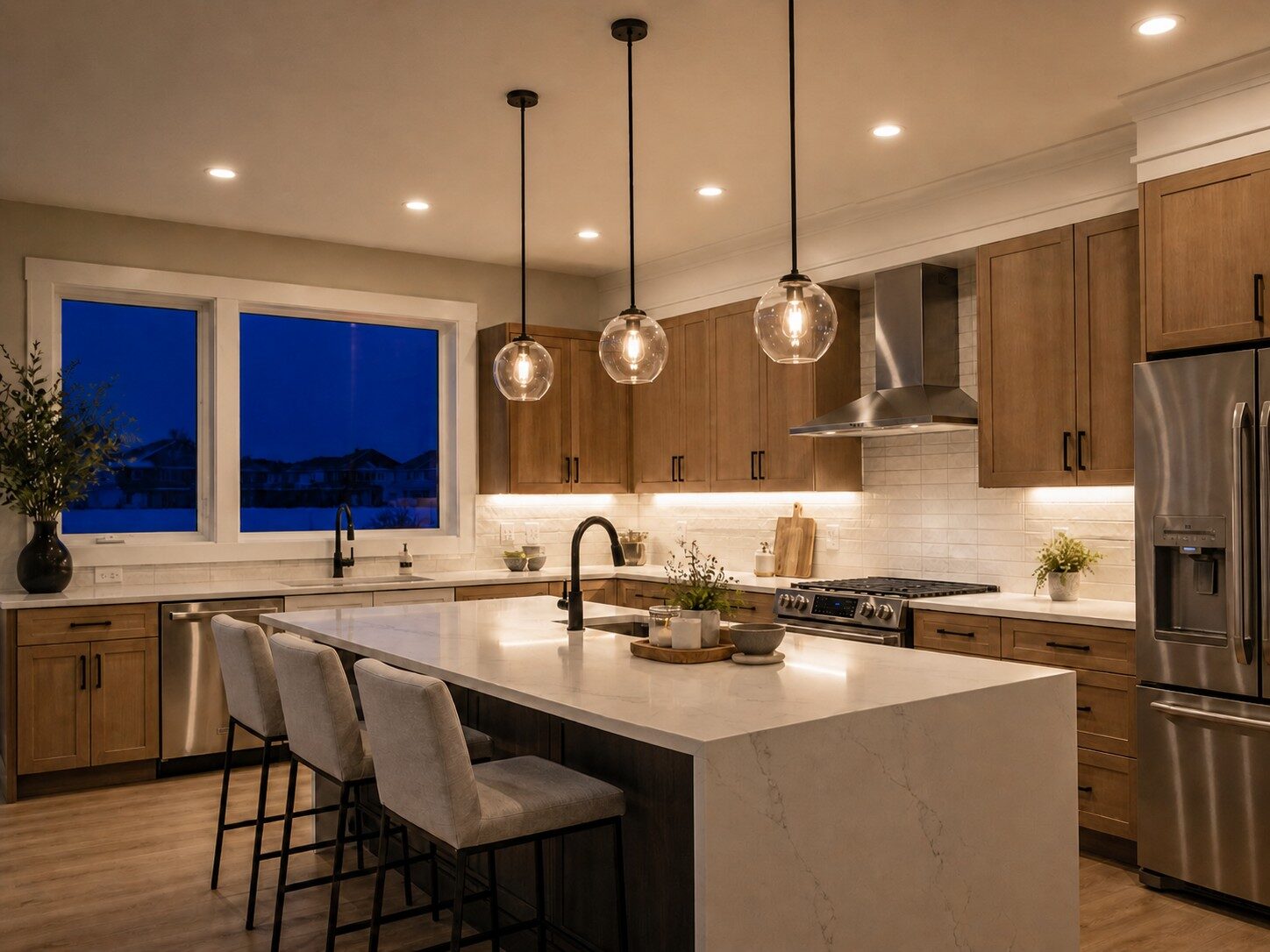
On December 21st, Red Deer gets exactly 7 hours and 48 minutes of daylight. By 4:30 in the afternoon, your new-build kitchen runs entirely on artificial light until well after breakfast the next morning. For roughly four months of the year, those pendants over your island are not decorative accents. They become the primary light source your family cooks, eats, and gathers under during Central Alberta’s long winter nights.
That reality changes everything about kitchen island lighting spacing. In Phoenix or Austin, a pendant choice is mostly about style and visual appeal. Here in Red Deer, it is about whether the light cast across your quartz countertop is even enough to chop vegetables safely at 5:00 PM in January, when the sun set thirty minutes ago.
Most national spacing guides assume mild winters, eight-foot ceilings, and moderate humidity. Your new build in the newer east-side neighborhoods, Laredo, or Evergreen matches none of those assumptions. The math must be different.
“We see the same mistake on almost every new-build walkthrough in Red Deer. The electrical rough-in happens before cabinetry is templated, so junction boxes get centered on the architectural plan rather than the actual island dimensions. A fifteen-minute coordination call between the electrician and cabinet installer prevents expensive rework later.”
Shannon Moench, Central Alberta Lighting
Ready to get the measurements right the first time? Visit our lighting showroom at #5 – 7619 50 Ave or call 403-352-8816 to see 2026 fixtures in person before you commit.
Why Red Deer New Builds Need Different Lighting Math
Three local realities shape how we think about pendant spacing in Central Alberta. Each one shifts the calculations you will see in generic home improvement guides.
Winter Darkness Changes Lumen Requirements
Red Deer sits at 52° north latitude, giving us one of the most dramatic seasonal daylight swings in populated Canada. In December, the sun barely clears 38° above the horizon at midday. You get under eight hours of natural light compared to June’s massive 16 hours and 42 minutes.
The practical impact: your island pendants carry the full task-lighting load for nearly half the year. A fixture that feels adequate in July will seem completely inadequate by January when it is doing all the heavy lifting.
Plan for 200 to 300 lumens of pendant output per linear foot of island surface. This provides even prep lighting without creating harsh shadows. Higher output can actually work against you by creating glare and uncomfortable bright spots.
Red Deer Electricity Rates Make LED Upgrades Worth the Math
The Rate of Last Resort in Red Deer sits at 12.06 cents per kWh for 2025-2026, but once you add delivery charges, transmission fees, and municipal access charges, most households pay between 16 and 22 cents per kWh for electricity they actually consume.
Run the numbers: a traditional 60W incandescent pendant operating three hours daily costs roughly $12 to $16 annually at local rates. The equivalent 9W LED pendant runs $1.80 to $2.40 per year. Over three pendants and ten years of ownership, that difference adds up to more than $400 in real savings, before factoring in LED longevity under optimal thermal conditions.
Every fixture Central Alberta Lighting stocks for new-build island applications is LED or LED-ready for exactly this reason.
Pro-Tip: Wattage – with LED bulbs we now have the options to put a higher wattage bulb in a fixture as “high wattage” bulb now is only 20 watts, creating 3x 60w incandescent bulbs worth of light.
Executive Build Ceiling Heights Keep Growing
A decade ago, nine-foot ceilings represented the premium standard in Red Deer new construction. Today, ten- and eleven-foot kitchen ceilings appear as standard features in executive builds, particularly in the Timberlands development and the expanding south-end subdivisions near Laredo or northeast such as in Evergreen..
The pendant spacing rules shift dramatically once you exceed eight feet. The visual proportions that work in a standard ceiling height kitchen can look completely wrong in today’s taller spaces.
Pro-Tip: Coordinate pendant placement during electrical rough-in, not after drywall installation. Central Alberta Lighting at Rave Design Showroom provides detailed fixture specification sheets to the home builders during new-build planning phases to prevent costly junction box relocation later in the construction process.
The 2026 Height Standards for Red Deer New Build Kitchens
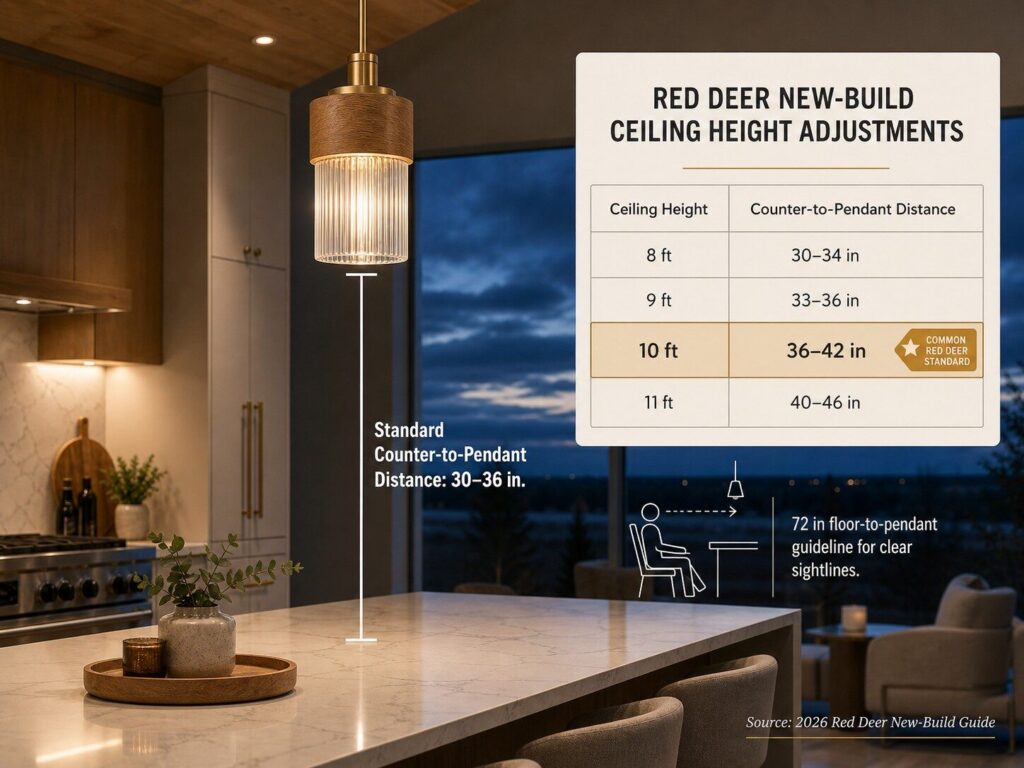
The industry baseline remains consistent: 30 to 36 inches from island countertop to fixture bottom. This measurement works reliably for standard eight-foot ceilings. However, Red Deer’s taller new-build ceilings require careful adjustment to maintain proper visual proportion and functional clearance.
| Ceiling Height | Counter-to-Pendant Distance | Floor-to-Pendant Height |
|---|---|---|
| 8 ft | 30–34 in | ~66–70 in |
| 9 ft | 33–36 in | ~69–72 in |
| 10 ft | 36–39 in | ~72–74 in |
| 11 ft | 42 in | ~72–74 in |
| 12 ft+ | 45 in | ~72-74 in |
The rule of thumb: add approximately 3 inches of pendant drop for every foot of ceiling height above the standard 8 feet. This maintains visual balance while preventing fixtures from floating too high in the space.
Keep the fixture bottom around 72 inches from floor level to maintain clear sightlines across open-concept kitchens. This height allows comfortable conversation flow while keeping the light source out of seated diners’ direct eye line.
“We consistently recommend 36 inches for counter clearance on 10-foot ceilings in our Red Deer installations. It feels natural when you are prepping food and keeps the pendants completely out of your sight line when seated at the island eating breakfast.”
Jennifer L., Red Deer Homeowner
Browse our complete pendant height collection specifically curated for Red Deer’s taller new-build ceiling specifications.
Horizontal Spacing Between Fixtures: The 2026 Mathematical Approach
Think of pendant spacing like hanging artwork in a gallery. Place pieces too close together and they compete for visual attention, creating chaos. Space them too far apart and coverage gaps leave awkward dark zones that you will notice every single evening during Red Deer’s long indoor lighting season.
The Standard Spacing Foundation
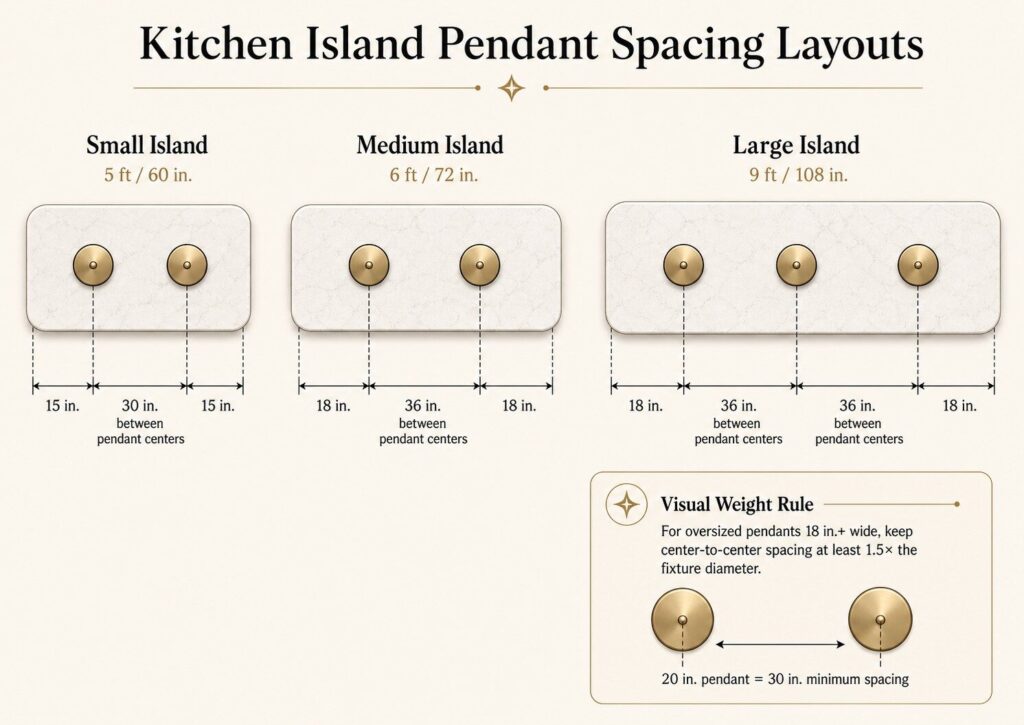
Space multiple fixtures 24 to 32 inches apart, measured centre-to-centre between fixture mounting points. Tighter than 24 inches and the individual fixtures start competing for visual dominance. Wider than 32 inches and task-light coverage drops off noticeably in the middle zones of your island surface.
Leave 6 to 12 inches of clear space between island edges and the outer boundary of your closest fixtures. Crowding fixtures too close to the island ends makes the entire arrangement feel visually squeezed and unbalanced.
Two-Pendant Formula for Smaller Islands (4 to 7 Feet)
Most Red Deer new-build islands fall within this range. The mathematical approach is straightforward: divide total island length by four, then place pendant centers that calculated distance from each end.
- 6-foot (72-inch) island: Place pendant centers 18 inches from each end, creating 36 inches between fixture centers
- 5-foot (60-inch) island: Place pendant centers 15 inches from each end, creating 30 inches between fixture centers
This formula works reliably for standard-sized fixtures. However, visual weight becomes critical when selecting oversized statement pieces.
Rule of Three for Longer Islands (7+ Feet)
Islands exceeding seven feet in length require three fixtures to achieve visual balance and adequate task lighting coverage. The layout process involves centering the middle pendant precisely, then spacing flanking fixtures equally while maintaining minimum 24-inch gaps between all fixtures.
For a typical 9-foot (108-inch) island: position the centre pendant at the 54-inch mark, with flanking pendants placed approximately 18 inches from each end. This configuration provides 36 inches between each fixture pair, satisfying spacing guidelines while ensuring even light distribution.
The Oversized Fixture Exception
2026’s dominant trend toward statement fixtures fundamentally changes the spacing mathematics. When selecting pendants 18 inches or larger in diameter, apply the 1.5 times fixture diameter rule for center-to-center spacing.
A pair of 20-inch diameter pendants requires minimum 30-inch spacing between centers. A pair of 24-inch pendants needs 36-inch spacing. This prevents visual crowding that mathematical formulas alone cannot predict.
“The biggest installation mistake I encounter involves applying small-pendant mathematics to oversized statement fixtures. A 24-inch pendant positioned 18 inches from an island’s edge looks visually crowded and disproportionate, regardless of what standard formulas suggest. Some pendants 18+ weigh more that 50lbs (most dome pendants are thin material – lighter weight. Glass, crystal + metal accents add weight) Visual weight and scale matter as much as precise measurements.”
Shannon Moench, Central Alberta Lighting
Shop our complete oversized pendant collection featuring 2026’s trending matte brass and honey-oak finishes from Kuzco, Hinkley, and DVI in our Red Deer showroom.
Layered Kitchen Lighting: The Foundation Beyond Island Pendants
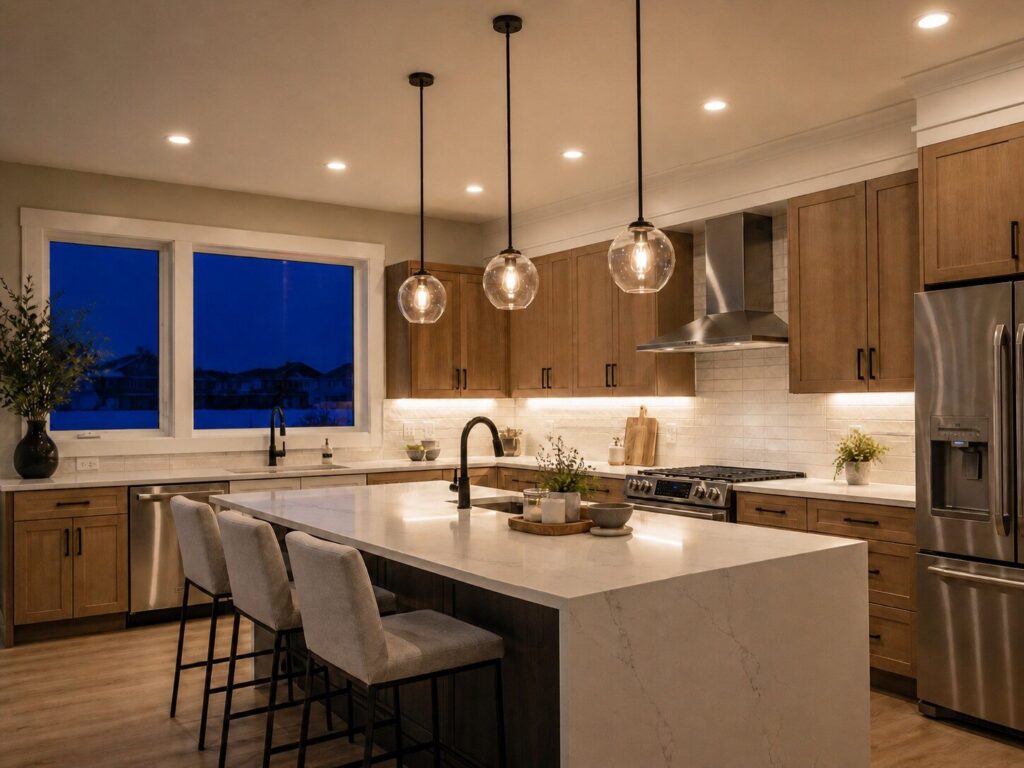
Professional kitchen lighting functions like a well-conducted orchestra. The island pendants serve as the lead instruments, capturing attention and providing focused illumination. But they require supporting players to create a complete, functional lighting symphony that works during Red Deer’s extended indoor seasons.
The Three Essential Lighting Layers
Ambient lighting provides the foundational illumination that fills your entire kitchen space. Plan for four to six recessed fixtures in a typical 12×14-foot new-build kitchen with nine-foot ceilings. Space these fixtures roughly four feet apart for general circulation areas, but tighten spacing over primary work zones where task performance matters most.
Task lighting delivers focused illumination for specific kitchen activities. Your island pendants handle island-based food preparation. Under-cabinet LED strip systems eliminate shadows on perimeter countertops where most food prep actually occurs. These strips should be planned simultaneously with island pendants because retrofitting after drywall installation creates significantly more complexity and expense.
Accent lighting adds visual depth and creates memorable atmosphere after dark. Consider toe-kick LED strips, inside-cabinet display lighting for glass-front cabinets, or discrete picture lights highlighting architectural features or artwork. This layer transforms purely functional kitchen space into an inviting room where people want to gather.
The layering principle becomes even more critical during Red Deer’s winter months when these fixtures carry the lighting load for extended periods every day.
“We upgraded from just recessed cans and island pendants to full three-layer lighting during our renovation. The difference between functional lighting and truly comfortable lighting is remarkable. We went from feeling like we were working in a commercial kitchen to having the most inviting gathering space in our neighborhood.”
Mark T., Red Deer Homeowner
Explore complete kitchen lighting packages designed specifically for Red Deer’s climate demands at Central Alberta Lighting.
2026 Style Trends Reshaping Red Deer New Build Kitchens
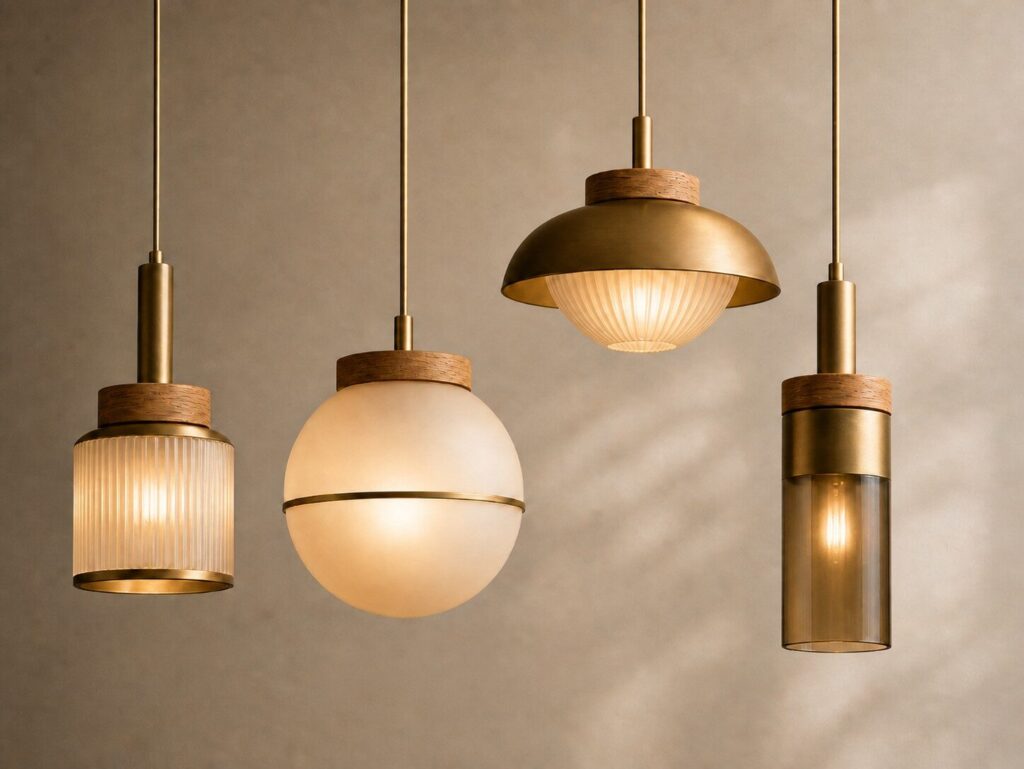
Three distinct stylistic directions dominate Red Deer new construction lighting selections this year. Each trend responds to our unique geographic and cultural context while reflecting broader design movements.
Warm Minimalism Replaces Industrial Aesthetics
The polished chrome and industrial black finishes that dominated the previous decade are giving way to warmer, more organic materials. Matte brass hardware, honey-oak wood accents, and smoked or ribbed glass diffusers create softer, more inviting illumination.
These warmer tones prove especially beneficial in climates where artificial lighting operates extensively. The harsh reflectivity of chrome and the stark contrast of matte black can feel oppressive during extended indoor seasons.
Oversized Statement Pieces Gain Prominence
Two large, dramatic pendants have decisively overtaken three smaller fixtures as the preferred configuration for islands six feet and longer. This shift creates calmer, more sophisticated lighting while often providing superior task illumination through higher individual fixture output.
The trend pairs particularly well with the enlarged islands now standard in Red Deer executive builds. Larger fixtures complement larger architectural elements more successfully than multiple smaller pieces.
Smart Dimmer Integration Becomes Standard
Every island fixture specification in 2026 should include compatible smart dimming capability. LED fixtures typically require trailing-edge dimmer technology designed for electronic loads rather than traditional leading-edge dimmers created for incandescent bulbs.
Consider minimum load requirements when installing only two LED fixtures per dimmer circuit. Some dimmer models require higher combined wattage to function properly.
During winter months, you will operate island pendants at full output for task performance. During peak summer daylight, 40 percent output often provides adequate supplemental illumination.
Browse our complete 2026 trend collection featuring exclusive pieces from Kuzco, Hinkley, DVI, and Progress Lighting at our Red Deer showroom location.
Red Deer Humidity Considerations and Installation Realities
February and March humidity levels in Red Deer average approximately 88 percent, creating condensation risks when cold exterior air meets warm interior moisture. This becomes particularly problematic inside recessed lighting cans positioned above kitchen areas, especially in vaulted or scissor-truss ceiling constructions that vent into unconditioned attic spaces.
Specify IC-rated airtight housings for all recessed fixtures installed above kitchen areas. IC-rated certification means the fixture can safely contact insulation materials. Airtight certification prevents moisture infiltration that can lead to condensation problems inside the fixture housing. Both certifications matter in insulated ceiling applications and should be specified together.
For pendant installations, ceiling junction boxes must support total fixture weight plus installation stresses. Standard electrical boxes carry ratings to 50 pounds maximum load. A handful of oversized pendant fixtures (18+ inches in diameter) exceed this threshold and require fan-rated boxes or independent structural support brackets.
New electrical circuits, junction box installations, and structural modifications require licensed electrician work and City of Red Deer building permits. Your builder typically handles permit acquisition and contractor coordination, but confirm that kitchen lighting rough-in appears specifically in your electrical scope documentation.
Need installation coordination assistance? Our project management services include trade partner recommendations, technical specification development, and installation timeline coordination.
Authentic Red Deer Homeowner Experiences
“The lighting design team at Central Alberta Lighting literally saved us from a huge expensive mistake during our new build process. Our builder had positioned the electrical boxes centered perfectly on our original 7-foot island plan, but we decided to upgrade to an 8.5-foot island after seeing similar installations in the Timberlands neighborhood. Shannon caught the discrepancy during our pre-drywall walkthrough and coordinated with our electrician to relocate the boxes before any additional construction occurred.”
Sarah M., Red Deer Homeowner
“We originally planned three smaller pendants over our large island because that seemed like the standard approach. After visiting the Central Alberta Lighting showroom and seeing their oversized fixture displays, we switched to two substantial Kuzco statement pieces. The entire kitchen feels more proportional and sophisticated now, plus the light coverage across our prep surfaces is actually more even than our original three-pendant design would have provided.”
David K., Red Deer Homeowner
Read additional customer experiences and reviews from Red Deer homeowners, builders, and trade professionals who have worked with Central Alberta Lighting.
Comprehensive Frequently Asked Questions
How much should I budget for kitchen island pendant lighting in Red Deer new builds?
Fixture costs typically range from $400 to $2,500 for two or three pendants, depending on size, brand, and finish complexity. New construction electrical labour runs approximately $150 to $400 total for island circuit installation, since electricians are already on-site during rough-in phases. Retrofit installation requiring new junction boxes costs $250 to $500 per fixture due to access complications and drywall repair requirements.
Do LED pendant fixtures actually deliver meaningful savings at current Red Deer electricity rates?
Yes, the savings prove substantial over fixture lifespan. With local retail rates averaging 16 to 22 cents per kWh including delivery and service charges, a traditional 60W incandescent pendant operating three hours daily costs approximately $12 to $16 annually. An equivalent 9W LED pendant costs $1.80 to $2.40 per year. Over three fixtures and ten years of typical ownership, total savings exceed $400, plus LED fixtures typically last significantly longer under optimal thermal conditions.
How does Red Deer’s high humidity affect kitchen lighting fixture selection?
February and March humidity in Red Deer averages around 88 percent, and active kitchens add additional moisture through cooking activities. Specify IC-rated airtight housings for all recessed cans positioned above kitchen areas to prevent condensation formation inside fixture housings. Any fixture mounted directly above sink areas should carry damp-rated certification at minimum. Wet-rated certification is only required for fully exposed outdoor installations or direct shower area applications.
Do pendant fixture upgrades require building permits or licensed electrician work in Red Deer?
Any new electrical circuits, junction box installations, or structural modifications require licensed electrician work and City of Red Deer building permits. Direct like-for-like fixture replacements using existing properly sized junction boxes may not require permits, but verify requirements with your local building department since permit requirements vary by municipality. Most island pendant projects involve box relocation or new circuit installation, which does trigger permit requirements.
Can I successfully mix different pendant fixture styles over a single island?
Yes, mixed pendant installations are trending strongly in 2026 new builds. Successful combinations share either consistent finishes (all matte brass hardware, all smoked glass with matching metal accents) or coherent design languages (all warm organic styling, all geometric minimalist forms). Ensure compatibility in both visual weight perception and structural mounting requirements. Bring photographs of your island design and cabinetry selections to our showroom, and our lighting design team will select fixtures that complement rather than compete with each other.
What distinguishes trailing-edge from leading-edge dimmers for LED fixture compatibility?
LED fixtures typically require trailing-edge dimmer technology specifically designed for electronic loads rather than resistive incandescent loads. Leading-edge dimmers designed for traditional incandescent bulbs can cause LED flickering, audible buzzing, or significantly shortened fixture lifespan. Our lighting specialists can recommend appropriate dimmer models for your specific fixture selections during your design consultation.
How can I determine whether my ceiling junction box adequately supports oversized pendant fixtures?
Standard residential electrical boxes carry maximum weight ratings of 50 pounds including fixture weight plus installation stresses. A handful of oversized pendant fixtures (18+ inches in diameter) exceed this threshold and require fan-rated junction boxes or independent structural support brackets anchored to ceiling framing members. Check fixture specification sheets for exact weights before finalizing installation plans.
Should I schedule island lighting installation before or after countertop fabrication and installation?
Electrical rough-in work, including junction box positioning, should occur before countertop templating and installation phases to ensure proper alignment with final island dimensions. However, final fixture installation typically occurs after countertop completion to prevent construction damage to finished lighting fixtures. Coordinate this installation sequencing with your builder and electrician during early planning phases to avoid scheduling conflicts.
Ready to Get Your Island Lighting Specifications Right?
Kitchen island lighting represents one of the most visible, frequently used fixture decisions in your entire home. Properly spaced, appropriately sized fixtures will perform quietly and effectively for the next fifteen to twenty years. Incorrectly specified lighting becomes a daily reminder that fixture selection happened after electrical rough-in rather than during careful planning phases.
Central Alberta Lighting has guided Red Deer area new-build lighting decisions for more than a decade. Our 17,500-square-foot showroom displays fixtures from Kuzco, Hinkley, DVI, Progress, Z-light, and Vinci under actual lighting conditions, allowing you to evaluate fixture performance and visual appeal before making final selections.
Schedule your lighting design consultation by calling 403-352-8816 or booking a showroom visit online. Bring your kitchen plans and elevation drawings if you are currently mid-construction. Bring your finish palette, cabinet selections, and countertop samples if you are still in design development phases.
Download your Kitchen Island Spacing Reference Guide containing all measurement formulas, ceiling height adjustments, and Red Deer-specific considerations in convenient printable PDF format.
Need comprehensive kitchen design services beyond lighting selection? Rave Interior Designs provides complete design development, product coordination, and installation management services under the same roof as Central Alberta Lighting, ensuring seamless project execution from concept through completion.
- Countertops
- Interior Decor
- Kitchen
- Lighting
You Might Also Like
-
- Gemstone Lights
- Lighting
June 25, 2026
Gemstone Lights – Why Exterior LED Lighting is Worth it for Alberta Homes
-
- Countertops
- Blog
- Kitchen Renovation
April 15, 2026
Countertop Edge Profiles Explained: Which One Is Right for Your Red Deer Kitchen?
-
- Lighting
February 11, 2026
Winter Renovations: Are They Worth It? A Smart Guide to Interior Upgrades